Kiniksa Pharmaceuticals International (KNSA)·Q4 2025 Earnings Summary
Kiniksa Posts First Full Profitable Year as ARCALYST Hits $677M
February 24, 2026 · by Fintool AI Agent
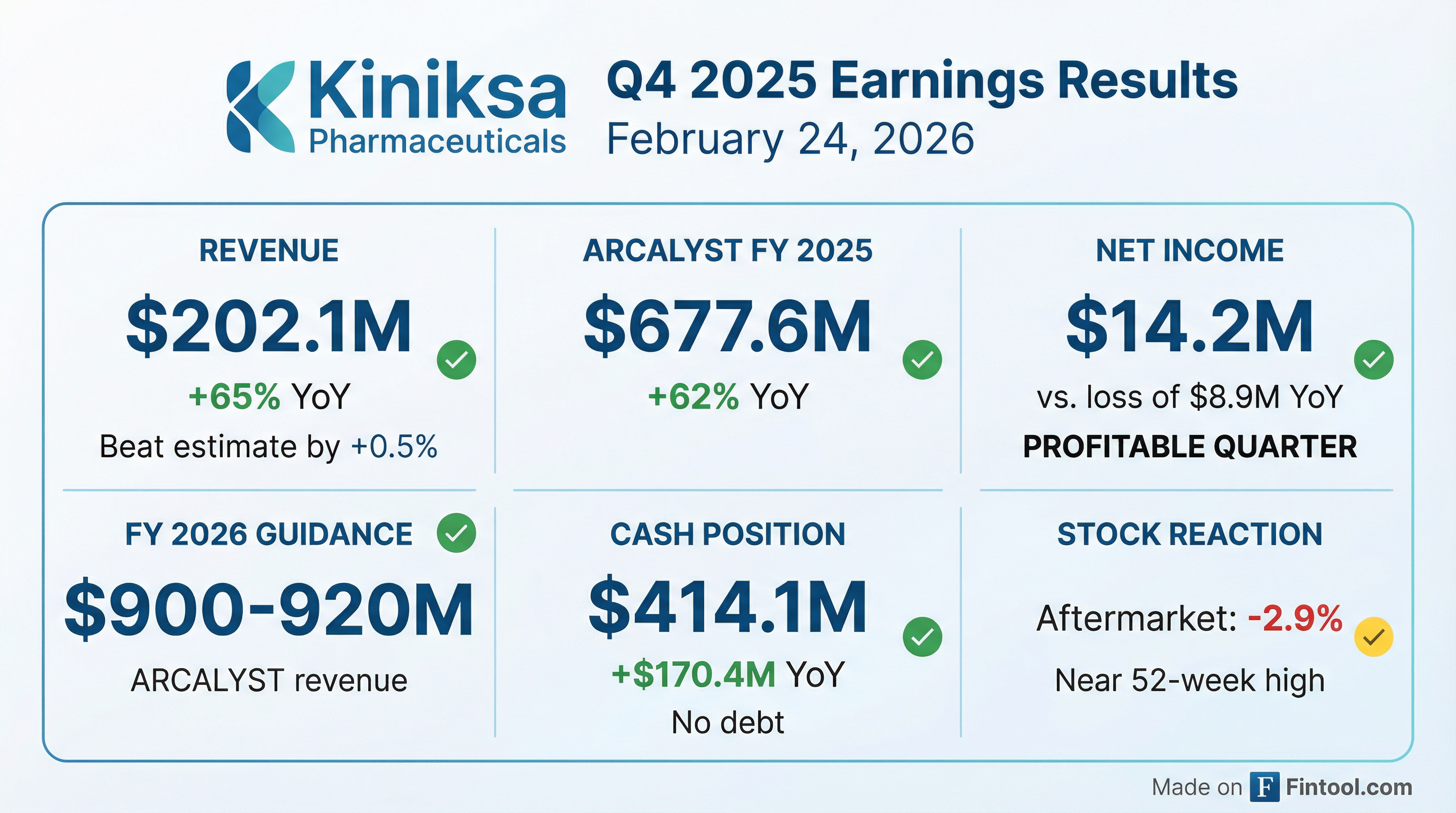
Kiniksa Pharmaceuticals reported Q4 2025 results that capped its first full profitable year, with ARCALYST revenue jumping 65% year-over-year to $202.1 million . The company guided 2026 ARCALYST revenue of $900-920 million, essentially matching consensus expectations . Shares dropped 2.9% in after-hours trading despite the strong operational results, likely reflecting profit-taking after a 141% run over the past year.
Did Kiniksa Beat Earnings?
Kiniksa narrowly beat revenue estimates but showed significant GAAP EPS variance versus consensus:
The EPS miss versus consensus likely reflects differences in share-based compensation adjustments. More importantly, Kiniksa swung from a net loss of $8.9 million in Q4 2024 to a profit of $14.2 million — its fourth consecutive profitable quarter .
Full-Year 2025 Results:
 Ask Fintool AI Agent
What Did Management Guide?
Kiniksa's 2026 guidance was essentially in line with Street expectations:
CEO Sanj K. Patel highlighted the team's execution: "We are working diligently, some would say like the clappers, to continue that strong trajectory in the year ahead" . The guidance of $900-920M implies 33-36% YoY growth, a deceleration from 2025's 62% but still robust for a maturing commercial product.
Key Commercial Metrics:
- ~18% of the 14,000 multiple-recurrence pericarditis patients now on ARCALYST treatment
- 4,150+ prescribers have written ARCALYST prescriptions since launch, with 29% (1,200+) having written for 2+ patients
- Average duration of therapy approaching 3 years, supported by strong patient adherence
- Gross-to-net improved to 8.4% from 9.8% in 2024 due to Inflation Reduction Act impacts
Q1 2026 Outlook: Management flagged "seasonal headwinds in the specialty drug sector associated with payer plan changes and co-pay resets" . Additionally, Q1 2025 benefited from a one-time patient bolus related to IRA Medicare Part D changes that won't recur .
How Did the Stock React?
KNSA dropped 2.9% in after-hours trading to $46.01, pulling back from its regular session close of $47.39:
The pullback appears to be profit-taking rather than fundamental concern. The stock hit its 52-week high of $49.12 earlier today before reversing. Over the past year, KNSA has outperformed most biotech peers as ARCALYST's commercial success validated the recurrent pericarditis opportunity.
What Changed From Last Quarter?
Positives:
- Profitability inflection complete — Fourth consecutive profitable quarter, FY 2025 net income of $59M vs. loss of $43M in FY 2024
- Cash generation accelerating — Cash increased $170.4M to $414.1M with no debt
- Gross-to-net improving — 8.4% vs. 9.8% YoY, indicating favorable payer mix
- Pipeline advancing — KPL-387 Phase 2 data expected 2H 2026, KPL-1161 Phase 1 planned by year-end
Watch Items:
- Revenue growth deceleration — Guidance implies 33-36% growth vs. 62% in 2025
- Single-product concentration — 100% of revenue from ARCALYST
- EPS below consensus — GAAP results continue to trail adjusted estimates
Q&A Highlights
Analyst questions focused on market penetration ceiling, patient segmentation, and pipeline progress:
On peak penetration potential (TD Cowen): CEO Sanj Patel declined to quantify peak penetration but emphasized "there's still an awful lot of growth that we can capture with Arcalyst" . COO Ross Moat added context: "We're around 18% penetrated into the target population of patients with two or more recurrences. That's a 14,000 population... without taking into account those patients earlier on in the disease, on their first recurrence, which is a much larger group of patients — around 26,000 patients in any given year" .
On first recurrence vs. 2+ recurrence growth (Wells Fargo): Moat noted that first recurrence patients now represent ~20% of all Arcalyst prescriptions, up over time as physicians "get more and more comfortable" . He emphasized that high-risk first-recurrence patients with significant effusions or cardiac tamponade "could be helped within label for Arcalyst" .
On persistence rates between populations (Citi): "We haven't seen anything meaningfully different between those two populations, whether it's those patients that have been suffering for 2 or more recurrences or on their first recurrence... these groups of patients generally suffer from chronic multi-year disease" .
On KPL-387 Phase 3 enrollment (JP Morgan): CMO Dr. John Paolini confirmed Phase 2 data expected in 2H 2026 and guided to "bringing this drug to patients in the 2028, 2029 time frame" . Phase 3 initiation timing has not yet been disclosed.
On KPL-387 market research (Jefferies): Moat shared compelling data: "Around 75% of all recurrent pericarditis patients said they would prefer the target product profile of KPL-387" with its monthly auto-injector dosing, and "greater than 90% of healthcare professionals say they are highly likely to prescribe KPL-387 for new patients" .
Pipeline Updates
Kiniksa outlined key pipeline milestones for 2026:
KPL-387's target product profile centers on "less frequent dosing, a streamlined preparation, and a patient-friendly administration format" via auto-injector . Management believes this could "address key patient needs and expand penetration into the addressable market" . CMO Dr. Paolini confirmed the FDA has "affirmed our belief that the Phase II trial would be sufficient and pivotal for registration in the U.S." .
KPL-1161 is an "Fc-modified IL-1 alpha and beta inhibitor" in preclinical development . More details will be shared as the program progresses to the clinic.
Ask Fintool AI AgentCapital Position
Kiniksa ended 2025 in its strongest financial position ever:
CEO Patel noted the robust financial position "gives us the ability to create additional value by investing in R&D and advancing internally discovered and developed assets... as well as pursuing strategic business development" .
Key Risks
- Single-product dependency — ARCALYST represents 100% of product revenue; any commercial or competitive setback would be material
- Pipeline execution — KPL-387 and KPL-1161 are early-stage; clinical success is uncertain
- Reimbursement pressure — While gross-to-net improved in 2025, future healthcare policy changes could impact pricing
- Market penetration ceiling — At ~18% of addressable patients, significant growth remains but adoption curves typically flatten
Forward Catalysts
Ask Fintool AI AgentView the full earnings transcript or explore more about Kiniksa Pharmaceuticals.